A £10 board can be the right choice for a one-day event, while the same board can be a false economy on a busy building site. That is the practical question behind dibond signs vs correx: not simply which material is better, but which one will do the job for the time, location and budget you have in mind.
Both are widely used for printed signs across the UK. Both can carry clear full-colour graphics, safety messages, directional information and branding. The difference is in how they are made, how they perform once fitted, and how long you need them to remain presentable.
Dibond signs vs correx: the material difference
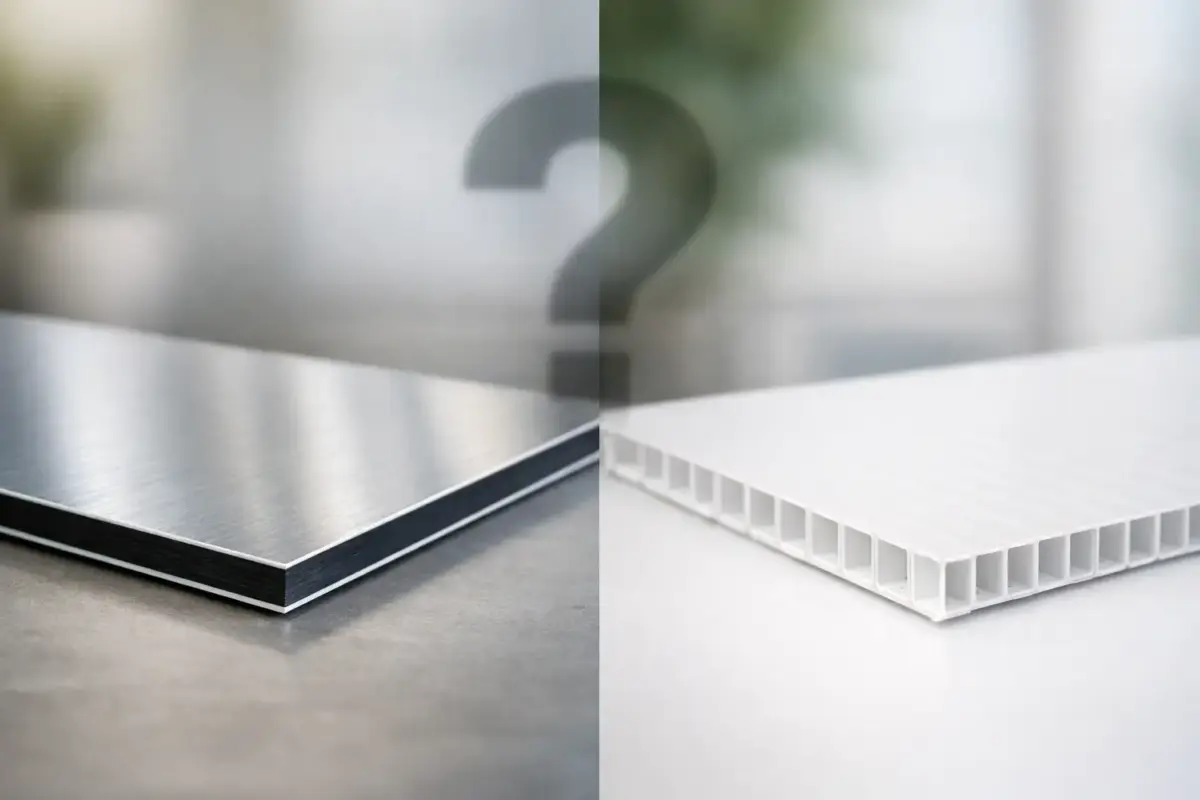
Dibond is an aluminium composite material. It has a solid plastic core faced with thin aluminium sheets, producing a flat, rigid panel with a professional finish. The material is often chosen for long-term business signs, site boards, shop signage, parking notices and branded displays.
Correx is a corrugated polypropylene sheet. Its internal fluted structure makes it lightweight and economical, while still giving enough stiffness for many short-term signs. Estate agent boards, temporary site notices, event directions and promotional boards are common uses.
At a glance, Dibond feels firm and substantial. Correx is lighter, has a slight give when handled and is usually easier to carry in quantity. Neither is automatically the right option. The intended lifespan is normally the clearest starting point.
Choose Dibond for a durable, professional sign
Dibond is designed for situations where a sign needs to stay flat, look smart and withstand regular exposure. It is a strong choice for exterior signs that may be seen by customers, visitors or passing traffic every day.
Because the panel is rigid, it holds its shape well when fixed to walls, fences, posts or frames. This matters for signs with detailed logos, price lists, property information or formal safety wording. A flat surface also gives printed graphics a cleaner, more permanent appearance.
Dibond is particularly suitable for business premises, retail fascias, car park signs, directional signage, construction project boards and long-running health and safety notices. It can also be used indoors where a more polished finish is needed, such as reception signs, display panels and wayfinding boards.
Where Dibond earns its higher price
Dibond generally costs more than Correx, but that extra spend buys durability and a longer useful life. If replacing a damaged temporary board several times would create disruption or extra labour, a Dibond sign may be the better-value choice from the outset.
It also suits locations where wind, rain and repeated handling are likely. No sign material is completely immune to poor installation or severe weather, but Dibond is far less likely to bend, crease or look tired after a short period outside.
For customer-facing applications, presentation is another consideration. A permanent-looking sign on a business entrance or retail unit reassures people that the information is current and the business is established. That impression can be worth more than the difference in material cost.
Choose Correx for temporary, low-cost signage
Correx is the practical option when you need signs quickly, in volume or for a defined short-term purpose. It is light enough for straightforward handling and fitting, making it useful for campaigns, events, open days, temporary parking instructions and changing site information.
For example, an event organiser may need dozens of directional signs for one weekend. A contractor may need temporary notices around a work area before permanent signage is installed. A retailer may want a short-run promotional display for a seasonal offer. In each case, Correx keeps the cost sensible without sacrificing clear printed communication.
The fluted structure can make Correx especially convenient for attaching to stakes or simple supports, depending on the sign format and fitting method. Its low weight also reduces the effort involved in transporting several boards to different locations.
When Correx is not the economical choice
Correx is weather-resistant, but it is not intended to match the lifespan or rigidity of Dibond. Over time, especially in exposed areas, it can bow, crease or become less tidy-looking. That makes it less suitable for prominent long-term signs or locations where brand presentation is a priority.
It is also worth considering how the sign will be fixed. A large Correx board in an open, windy location needs suitable support. Choosing a lighter sheet does not remove the need for safe, secure installation. If a sign must remain upright and readable for months, a more rigid board is usually the safer decision.
Compare Dibond and Correx by application
The quickest way to decide is to work backwards from the job. Think about where the sign will be installed, how long it must last, how it will be fixed and who needs to see it.
For long-term exterior branding, Dibond is normally the better fit. Shop signs, entrance boards, permanent site directions and professional property signage benefit from its flat finish and strength. It is also well suited to signs that are likely to be cleaned or handled regularly.
For temporary construction notices, the answer depends on duration. Correx works well for short projects, changing messages and temporary perimeter information. If the project runs for a long period, or the board will carry prominent client branding at the site entrance, Dibond is likely to provide a better result.
For events, Correx is often the sensible starting point. Direction arrows, parking instructions, race routes and one-off promotional boards do not usually need a multi-year lifespan. However, a recurring event that uses the same branded signs season after season may justify Dibond instead.
For estate and property boards, Correx remains popular because it is lightweight and cost-effective for campaign-based use. For fixed development signs, sales suite boards or higher-value presentation areas, Dibond offers a more substantial finish.
For indoor displays, both can work. Correx is useful for temporary promotions and point-of-sale messages, while Dibond gives a cleaner, sturdier result for reception areas, menus, fixed information panels and branded wall displays.
Consider size, fixing and artwork before ordering
Material choice should not be made separately from sign size and installation. A small temporary Correx sign may perform perfectly well. A large board exposed to wind places more demand on both the material and its fixings. In that situation, Dibond or a properly supported Correx solution may be required.
Plan where fixing holes are needed before production. Signs can be mounted to posts, fences, walls or frames, but the correct approach depends on the surface and the panel size. Keep key text, logos and QR codes away from the edges and any planned fixing points so they remain visible.
Artwork matters too. High-resolution files, clear contrast and readable text make a bigger difference than many people expect. A durable board cannot compensate for a message that is too small to read from its intended viewing distance. For safety, parking and directional signs, prioritise plain wording and strong contrast over crowded design.
If you are ordering several signs, group them by purpose. Permanent branded panels may need Dibond, while temporary route markers and short-term notices may be better ordered in Correx. This approach controls costs without using one material for every task simply because it is familiar.
Cost is about lifespan, not just unit price
Correx is usually the lower-cost option at the point of order. That makes it ideal when the sign has a short job to do. Dibond costs more, but its longer service life can make it the more economical board when replacement would be likely or inconvenient.
It helps to ask one direct question: will this sign still need to look good in six months? If the answer is no, Correx may be all you need. If the answer is yes, particularly for an outdoor or customer-facing location, Dibond is usually the more dependable investment.
There are exceptions. A sheltered indoor sign may not need Dibond even if it will be displayed for a long time. Equally, a temporary sign in a highly exposed position may need more than a basic Correx board. The setting always matters.
The right board makes ordering simpler
Dibond is the dependable choice for durable, professional signage. Correx is the efficient choice for temporary messages, events and cost-conscious short runs. Start with the sign’s working life and location, then select the board that matches it rather than paying for more material than the job requires.
If you are unsure, prepare the size, intended use and fitting location before ordering. Those three details will usually point you towards the right sign board quickly, and help ensure the finished sign works as hard as it needs to.