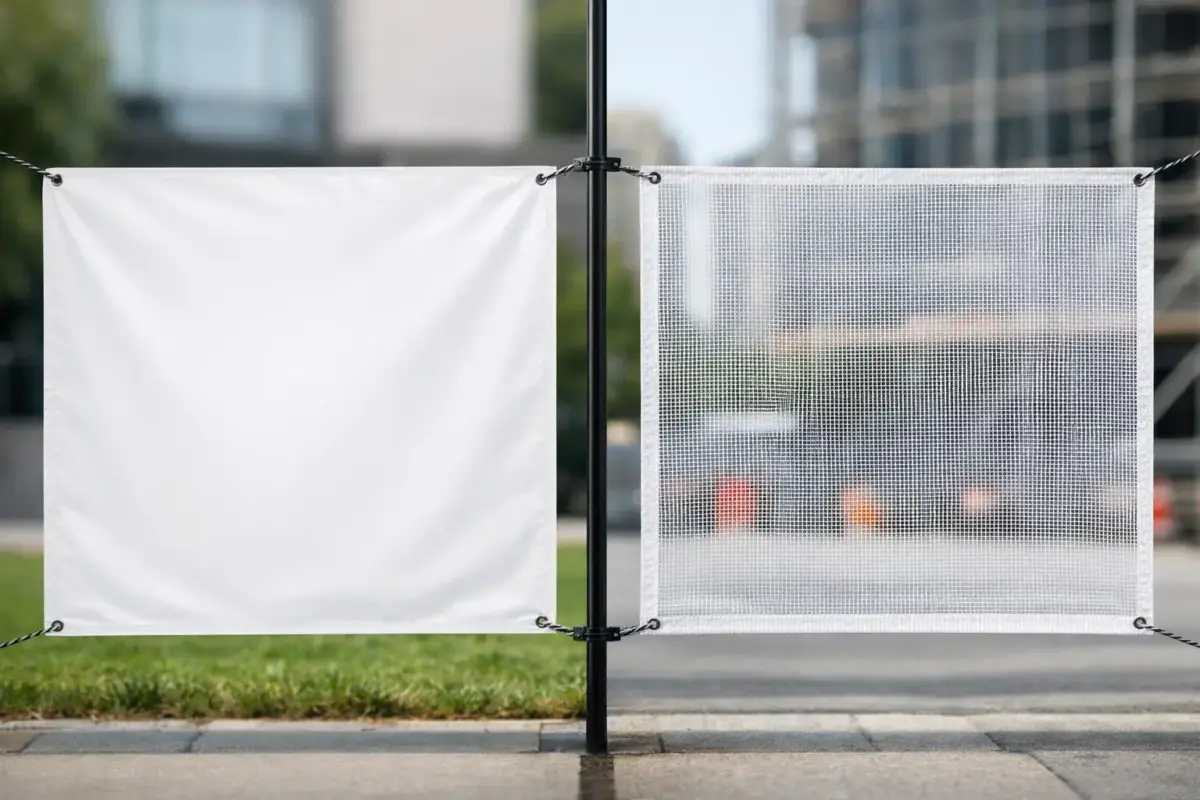
A banner fixed to a windy perimeter fence has very different demands from one displayed inside a showroom or across a market stall. Choosing the wrong material can leave you with a sign that pulls at its fixings, looks less clear than expected or costs more than the job requires. When comparing printed banners vs mesh banners, the main question is not which is better overall. It is which one suits the location, viewing distance and length of use.
Both options can carry your logo, message, contact details, promotional offer or site information in full colour. The difference is in the banner material itself. Standard printed banners provide a solid print surface, while mesh banners use a perforated material that lets air pass through.
Printed banners vs mesh banners: the core difference
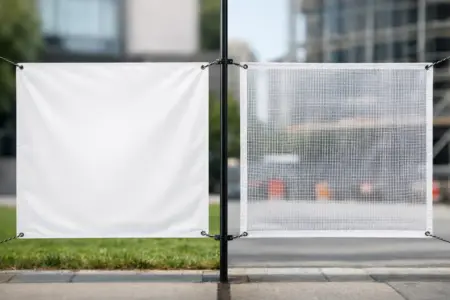
A standard printed banner is generally made from solid PVC banner material. It has a smooth, uninterrupted surface that gives graphics, photographs and smaller text a strong, clean finish. It is a dependable choice for indoor displays, shop promotions, event backdrops, building fronts and outdoor locations with limited wind exposure.
A mesh banner is printed on PVC material with tiny holes across its surface. From normal viewing distance, the design remains clear. Up close, the perforations are visible, and the colour can appear slightly less dense than on a solid banner. The benefit is that wind can pass through the material rather than pressing fully against it.
That makes mesh particularly useful for temporary site fencing, scaffolding, sports grounds, construction hoardings and other exposed outdoor areas. It reduces wind load, but it does not make a banner immune to poor fitting or severe weather. Correct eyelets, suitable fixings and a secure framework still matter.
Choose a standard printed banner when finish matters most
If people will view the banner at close range, a standard PVC banner is usually the stronger option. Its solid surface helps colours look richer and makes fine lines, small lettering and detailed logos easier to reproduce. This is especially useful where the banner is part of a customer-facing display rather than simply a large message seen from a distance.
For example, a retailer promoting a sale in a window, a hospitality venue advertising an event, or an exhibitor displaying branded graphics indoors will normally benefit from a standard banner. The material gives the artwork more impact and avoids the dotted appearance that mesh can show when inspected closely.
Standard banners are also a practical choice for short-term outdoor promotions in more sheltered settings. A banner on a wall, beneath a canopy, at a car park entrance or around a local event can work well where it is not repeatedly exposed to strong gusts.
The key limitation is wind. A solid banner acts more like a sail, particularly at larger sizes. If it is attached to open fencing or posts with air flowing freely around it, the material and fixings will take more pressure. Tightening it excessively is not the answer, as this can strain the eyelets and cause tearing around fixing points over time.
Choose a mesh banner for exposed fencing and sites
Mesh banners are designed for situations where wind management is a priority. The perforated surface allows a proportion of airflow through the banner, reducing the force placed on fence panels, rails and tie points. For many site managers, this is the deciding factor.
A mesh banner is well suited to construction sites, renovation projects, perimeter fencing, outdoor sports venues, festivals and roadside work areas. It can display contractor details, safety messages, directional information, development branding or sponsor graphics while making better sense of an exposed location.
It is also useful when a long run of fencing needs branding. A solid banner across several panels can catch a significant amount of wind. Mesh helps reduce that issue, although each section should still be measured and fitted correctly. Avoid treating one large banner as a substitute for secure fencing or a suitable wind-rated installation.
There is a visual trade-off. Because mesh has holes, it does not offer the same solid block of colour as standard PVC. Bold logos, high-contrast text and simple layouts work particularly well. Fine detail is possible, but small type, pale colours and intricate photographic images may lose some impact, especially if the banner is viewed close up.
Think about where people will stand
Viewing distance should shape the artwork as much as the material. A banner on site fencing may be read from the pavement, road or site entrance. In that situation, a large logo, a short message and clear contact details are more effective than a dense design, whether you choose mesh or standard PVC.
For close-range displays, use larger enough text to read comfortably and leave space around key information. Do not try to place every service, telephone number and social media message onto one banner. A banner needs to work in a few seconds. If people have to stop and study it, the main message is probably doing too much.
On mesh, keep the most important elements away from the outer edges and eyelets. This helps prevent wording or logo details from being interrupted by folds, fixings or tension points. Strong contrast is also valuable. Dark text on a light area, or light text on a dark area, will usually read more clearly than similar shades placed together.
Durability depends on installation as well as material
No banner material performs at its best without suitable fitting. Before ordering, measure the available area carefully and allow for the banner’s finished size, eyelets and fixing points. A banner that is too large for its location is difficult to tension evenly. One that is too small may leave gaps or look unfinished.
Use appropriate banner ties, bungee cords or fixings for the frame or fence. Bungees can be helpful in outdoor locations because they allow a little movement rather than putting all the stress directly onto the eyelets. Check the banner periodically, particularly after high winds, and replace damaged ties promptly.
For longer installations, consider the condition of the surface behind the banner. Sharp fence edges, rough metalwork and protruding fixings can rub against the material. On building sites, keep banners away from areas where plant, deliveries or pedestrian traffic are likely to catch them.
Cleaning is straightforward for both materials. Wipe surface dirt away gently with a soft cloth and mild soapy water, then allow the banner to dry before storing it. Avoid harsh cleaners and do not fold a damp banner for long periods, as trapped moisture can mark the print or encourage mildew.
Cost, lifespan and order quantities
Mesh is often the more practical spend when wind exposure is high, even if a standard banner appears cheaper for the same size. Replacing a torn solid banner, repairing fencing or dealing with failed fixings can quickly remove any initial saving. For a sheltered promotion, however, paying for mesh may not provide a meaningful advantage.
It also depends on how long the banner will be displayed. A one-day indoor event usually calls for a clean, solid print finish. A multi-month project perimeter needs a material chosen for the environment, with artwork that remains useful as the work progresses. If project details are likely to change, consider separate banner sections so one update does not mean replacing an entire run.
Ordering several banners at once can help create a consistent look across entrances, fences, reception areas and event spaces. Use the same logo files, colours and typefaces, but adjust the wording for each location. A large roadside mesh banner may need only your company name and phone number, while an entrance banner can include operating hours, visitor instructions or site rules.
Prepare artwork for the chosen banner
Start with the finished banner size, not just the design on screen. Artwork that looks balanced on an A4 proof can become sparse or overcrowded when enlarged to several metres wide. Use high-resolution images and vector logo files where available, as these reproduce more cleanly at large format.
Keep essential wording within a safe area away from the edges. This gives room for finishing and prevents important information sitting too close to eyelets. If you are uncertain about the layout, use a design service or submit your artwork for checking before production. A quick check at this stage is far easier than correcting a banner once it is fitted.
For mesh, favour bold branding and simple visual hierarchy. For standard PVC, you have more freedom with detail, but clarity should still lead the design. The strongest banner is not the one containing the most information. It is the one a customer, visitor or passer-by understands immediately.
The practical choice is straightforward: use standard printed banners where print finish and close-up visibility lead the brief, and select mesh where an exposed fence or open site needs better airflow. Measure the location, consider the weather, then build the artwork around the distance from which people will actually read it. That approach gives your banner the best chance of looking professional from the day it goes up.