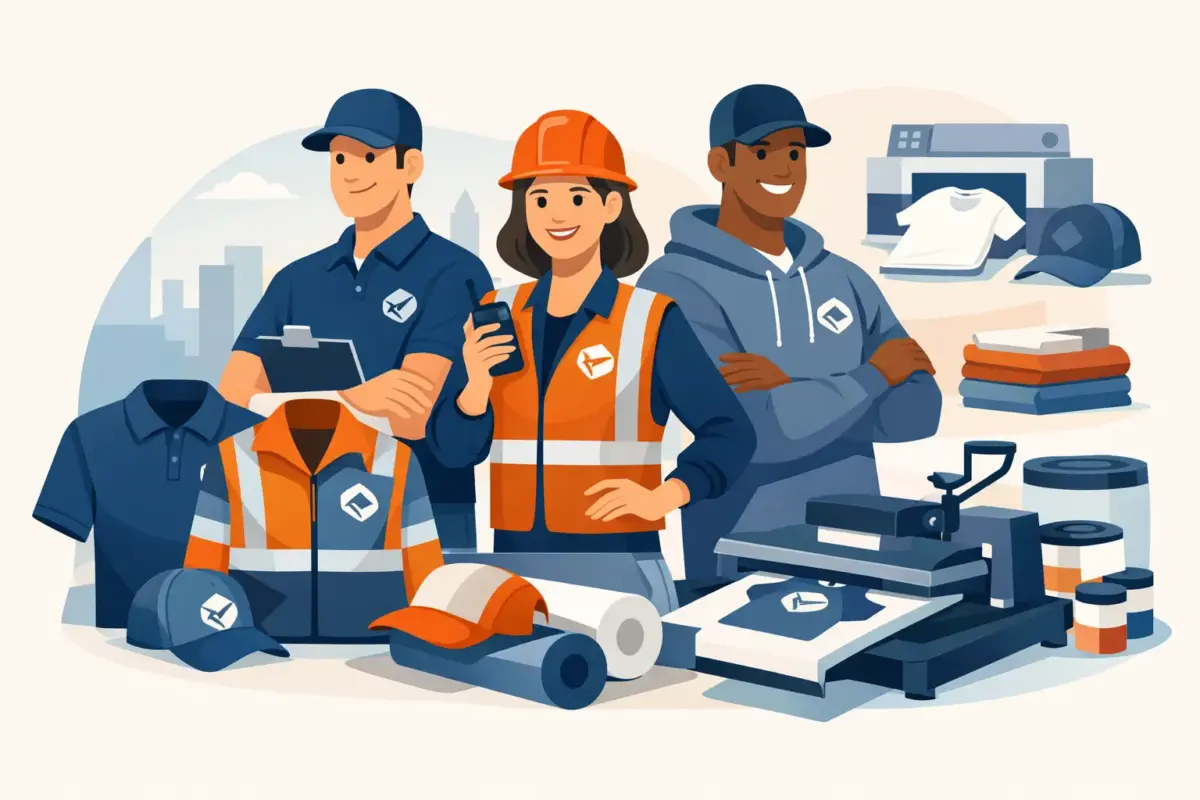
A plain hoodie or polo does the job of getting someone dressed for work. Branded workwear printing does more than that. It puts your company name in front of customers, helps staff look consistent on site, and gives your business a more established presence without adding much complexity to the order.
For many businesses, workwear sits in the same practical category as signage, vehicle graphics and site notices. It needs to be clear, durable and fit for purpose. A builder needs clothing that still looks presentable after repeat washing. A café needs staff uniforms that feel tidy and approachable. A delivery team needs garments that make it easy to identify who is turning up at the door. The print has to look sharp, but it also has to last.
Why branded workwear printing matters
Customers notice when a team looks organised. It does not matter whether you are sending one engineer to a domestic callout or staffing a full event crew. Matching printed clothing gives immediate visual recognition, and that builds confidence before anyone says a word.
There is a practical benefit too. Branded workwear printing turns everyday clothing into a low-effort marketing tool. Your logo on a polo shirt, softshell jacket or hi-vis layer keeps your name visible on site, on the road and at customer premises. Unlike a one-off advert, workwear keeps working as long as the garment is in use.
It also helps internally. Staff are easier to identify, new starters settle into a more professional standard quickly, and teams tend to take more care over presentation when the clothing is made specifically for the role. That may sound minor, but in customer-facing industries it makes a difference.
Choosing the right garments for the job
The best results usually come from matching the clothing to the working environment, not just picking the cheapest option. A printed T-shirt may be fine for indoor retail or short-term events, but it is less suitable for a trade team working outdoors through colder months. In those cases, polos, sweatshirts, hoodies, fleeces or jackets are often better long-term choices.
Hi-vis clothing brings another layer of consideration. If visibility is the main requirement, branding needs to support that function rather than compete with it. Print placement, size and colour all need to be handled carefully so the garment remains clear and professional.
Hospitality and retail teams usually care more about comfort, fit and appearance across long shifts. Tradespeople and site staff often prioritise durability and ease of washing. Event organisers may need a balance of smart presentation, quick turnaround and cost control for short-run orders. The right choice depends on where the clothing will be worn, how often it will be washed and what kind of impression it needs to create.
What to include on printed workwear
Most businesses do not need to overcomplicate the design. In many cases, a front chest logo and a larger back print are enough. The chest position gives a neat branded finish, while the back provides stronger visibility from a distance.
If your team works in public-facing roles, adding a website, phone number or short service description can make sense, especially on outerwear. If the garment is mainly for site identification or internal use, a simple logo may be the better option. Too much information can make workwear look cluttered, particularly on smaller garment sizes.
Colour choice matters as well. The print needs to contrast properly with the fabric and remain readable in everyday conditions. Fine details and very small text do not always translate well onto clothing, especially on textured fabrics. Clean, straightforward artwork usually performs best.
Branded workwear printing and durability
This is where many buying decisions are won or lost. A garment might look good when it is first unpacked, but if the print starts to crack, fade or peel after repeated washing, it stops representing the business properly.
Durability depends on several factors – the garment quality, the print method, the artwork itself and how the clothing is used. Heavy-duty workwear faces more abrasion and more frequent laundering than occasional promotional clothing. That means the right combination of garment and print specification matters more than a low headline price.
There is often a trade-off here. Budget garments can be useful for short-term promotions, event staff or one-off campaigns, but they may not offer the same lifespan as higher-quality workwear intended for daily commercial use. For businesses ordering for permanent teams, it is usually more cost-effective to choose clothing that can handle regular wear from the start.
How to order branded workwear printing without delays
The fastest orders tend to be the ones with clear artwork, clear quantities and a clear purpose. If you already have a logo, make sure the file is sharp enough for print and supplied in a usable format. If you do not, it helps to know what information needs to appear and where you want it placed.
Sizes are another common sticking point. Ordering a full range without checking what your team actually needs often leads to replacements and reorders. For regular staff issue, it is worth confirming garment types and sizes before production starts.
It also helps to think in terms of sets rather than one-off items. A polo for warm weather, a hoodie or sweatshirt for general use, and a jacket for outdoor work will often cover more situations than ordering a single garment type in bulk. That approach can give your team a more consistent look across the year.
Where customers want speed and minimal back-and-forth, a practical ordering route matters. Being able to design online, upload artwork or request support allows different buyers to work in the way that suits them. Some know exactly what they need. Others just need a dependable supplier to get the artwork into a print-ready format and move the job on efficiently.
When branded workwear printing makes the biggest impact
New business launches are an obvious example. A smart set of printed garments helps a young company look established from day one. That matters for trades, cleaning businesses, food service, delivery operations and pop-up retail in particular, where trust is built quickly and often face to face.
It also makes sense when a business is refreshing its branding. If your signage, vehicle graphics and printed clothing all carry the same updated identity, the result is far more consistent than changing one area at a time.
Seasonal peaks are another good moment to review workwear. Hospitality venues bringing in extra staff, event teams preparing for busy periods, and site managers coordinating temporary crews all benefit from clothing that makes roles clear and keeps branding visible. In those cases, turnaround and easy reordering are often just as important as the garment itself.
Common mistakes to avoid
One of the most common problems is choosing workwear based only on unit price. Cheap garments can look poor surprisingly quickly, and if staff stop wearing them because they are uncomfortable or worn out, the saving disappears.
Another issue is overcrowded artwork. A logo, phone number, web address, service list and slogan may all seem useful, but not every garment needs all of them. Clear branding is usually stronger than trying to fit everything onto one print area.
Poor colour matching can cause trouble too. A logo that looks fine on a white background may lose impact on navy, black or hi-vis yellow. It is worth checking how the design will sit on the chosen garment before production.
Then there is the simple matter of consistency. If half the team wear one logo version and the rest wear another, the brand starts to look muddled. Keeping artwork files, garment choices and print positions consistent makes reorders easier and the end result more professional.
A practical approach to branded workwear printing
The best branded clothing is not the flashiest. It is the clothing your team will actually wear, wash and rely on week after week. That means choosing garments that suit the job, keeping artwork clear, and ordering through a process that does not waste time.
For many businesses, branded workwear printing works best as part of a wider visual setup alongside signs, labels, banners and other printed materials. It helps customers recognise your business quickly and gives your team a professional standard to work to. If the clothing is right for the environment and the print is done properly, it becomes one of the simplest ways to look more established in day-to-day trade.
If you are ordering for the first time, start with what your staff genuinely need on the job, not what looks best in theory. That usually leads to better wear, better visibility and fewer regrets once the boxes arrive.