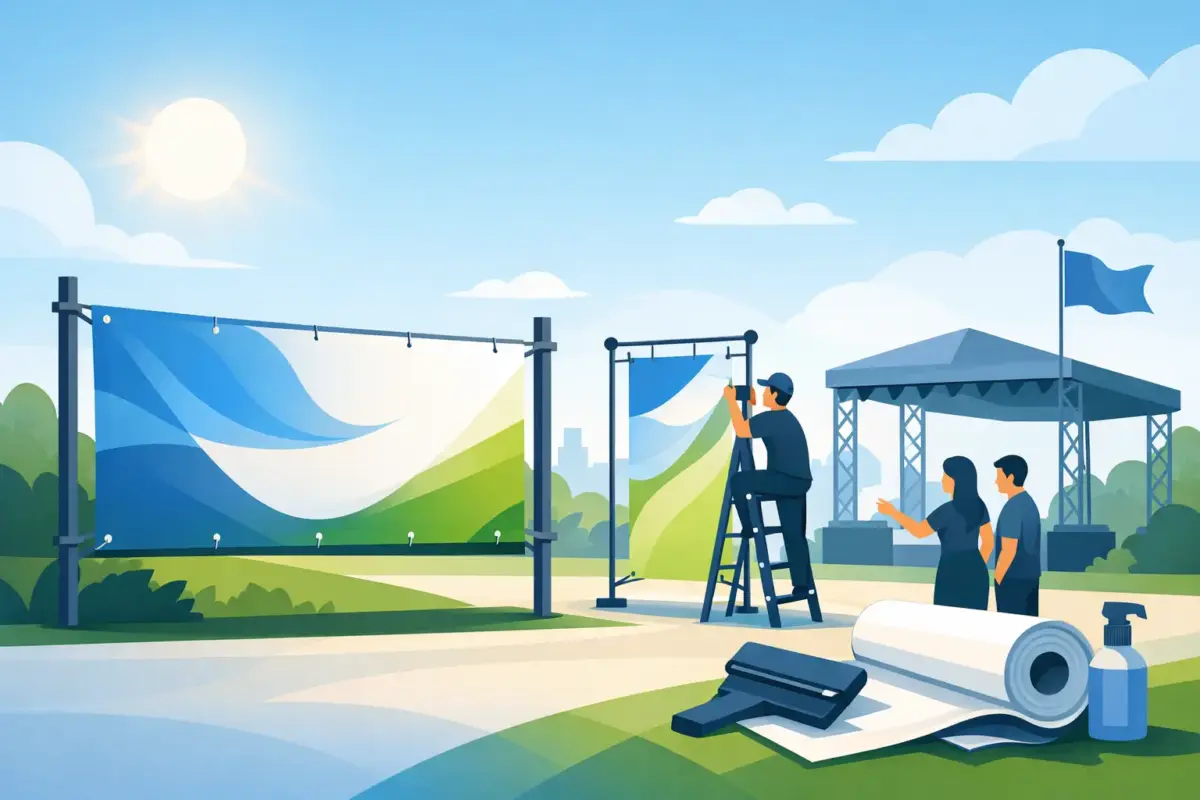
If your banner is going outside, it needs to do more than look good on screen. Event banners outdoor printing has to cope with wind, rain, changing light and the general wear that comes with setup, takedown and transport. A banner that works well at a village fete may not be the right choice for a busy roadside event, a sports fixture or a branded hospitality space.
That is why the best results usually come from matching the banner to the job, rather than choosing on price alone. Size, material, print method and finishing all affect how the banner performs once it is up. Getting those details right helps you avoid sagging edges, unreadable graphics and replacements you did not budget for.
What matters most in event banners outdoor printing
For most event organisers, the main requirement is simple: clear branding that stays visible throughout the event. In practice, that depends on a few practical factors working together.
Material strength is one of the first things to check. Outdoor banners need to stay stable when fixed to barriers, fencing or frames. Standard PVC banner material is a common choice because it is durable, weather resistant and suitable for short-term and repeat event use. Mesh banner material can be a better option in exposed locations because it allows some wind to pass through, reducing strain on fixings and support points.
Print quality matters just as much as material. Outdoor viewing distances vary, so artwork has to be designed for where people will actually see it. A banner beside a registration desk can carry more detail than one stretched across a field entrance. If the message has to be read quickly from a distance, simpler layouts tend to perform better than crowded designs.
Finishing is often overlooked until the banner is being fitted. Eyelets, hems and reinforced edges make a real difference to lifespan and ease of installation. A well-finished banner is easier to tension properly and less likely to tear under stress.
Choosing the right banner material for outdoor events
There is no single material that suits every event. The right choice depends on where the banner will be used, how long it needs to stay up and how often it will be reused.
PVC banners are the standard option for many event applications. They offer a good balance of print quality, weather resistance and cost, which makes them suitable for promotional displays, sponsor branding, directional signage and temporary perimeter graphics. They also roll and store reasonably well between uses, provided they are kept dry and handled with care.
Mesh banners come into their own where wind is a factor. If you are fixing banners to open fencing, scaffolding or roadside barriers, mesh can reduce sail effect and help the display stay secure. The trade-off is that print appears slightly less solid at close range because of the perforated surface. For long-distance viewing, that is rarely a problem.
For shorter promotions, lighter materials may be enough, but they are not always the best choice for repeated use. If your event calendar includes multiple dates across the season, spending a little more on a tougher specification often saves money overall.
PVC or mesh – which is better?
It depends on the site. If the banner is going on a wall, a frame or a sheltered fence line, PVC is often the better all-round option because it gives a stronger printed finish. If the location is exposed and likely to catch wind, mesh is usually the safer choice. The aim is not just a good-looking banner on day one, but a banner that still looks presentable at the end of the event.
Design for visibility, not just brand consistency
A common mistake with outdoor event banners is trying to include too much. Logos, social handles, sponsor marks, event schedules, web addresses and promotional messages can all compete for space. Outdoors, especially in crowded or fast-moving settings, less usually works better.
Start with the main purpose. Is the banner there to attract attention, mark an entrance, direct visitors or support sponsors? Once that is clear, the layout becomes easier to organise. A banner for wayfinding needs different priorities from a banner used behind a stage or across a market stall.
High contrast is important. Dark text on a light background or the reverse generally reads best in shifting daylight. Fine lines and small text can disappear outdoors, particularly if the banner moves slightly in the wind. Bold type, clear spacing and a focused message tend to deliver better results.
If you already have artwork, it is worth checking whether it was designed for print at full size. Social graphics and website visuals do not always scale up well. Low-resolution images, cramped text and narrow margins become much more obvious on a large banner.
Size and placement affect performance
Banner size should be based on viewing distance and fixing position, not just the space available. A large banner can make a strong impact, but only if the support structure can carry it properly and the design suits the format.
Long horizontal banners are often used for fencing, stage fronts and barrier runs. They work well for branding and sponsor panels because they follow the line of the event space. Taller banners can be useful at entrances, around hospitality zones or where you need branding to rise above crowds and parked vehicles.
Placement also affects durability. A banner fixed tightly in a sheltered spot will usually last better than one stretched across an exposed corner with uneven tension. If the banner will be close to foot traffic, consider whether the bottom edge could catch on equipment, footwear or handling during setup.
Planning the fixings before you print
This is where many banner orders either go smoothly or become awkward on the day. You need to know how the banner will be attached before artwork is finalised. Eyelet positions, overall dimensions and edge finishing should reflect the actual installation method.
For example, a banner tied to metal fencing may need regular eyelets around all sides. A banner fitted into a frame may need more precise sizing and reinforced edges. If the installation point is unusual, it is better to check the fixing details early rather than try to adapt a standard banner at the venue.
Event banners outdoor printing for repeat use
If you run recurring events, banner reuse becomes an important part of value. Seasonal events, touring displays, school functions, charity fundraising days and sports fixtures often need signage that can be packed away and used again.
In those cases, durability is only one part of the equation. Storage and transport matter too. A banner that folds badly, scuffs easily or retains moisture can lose its appearance even if the print itself is sound. Rolling banners rather than folding them helps reduce creasing, and storing them dry prevents mildew and material damage.
It is also worth thinking about design lifespan. Date-specific artwork is fine for one-off promotions, but a more general design can be reused over multiple events. Some organisers keep a set of evergreen branded banners for core signage and order smaller event-specific pieces separately when needed.
Common ordering mistakes and how to avoid them
Most problems with outdoor banners are preventable. The first is choosing the cheapest option without considering the site conditions. If the banner is going outside for several days, in poor weather or in a high-traffic location, specification matters.
The second is supplying artwork that looks acceptable at small size but breaks down when printed large. Blurry logos and unreadable text are still common, especially with rush orders. If there is any doubt, get the file checked before production.
The third is underestimating installation. A well-printed banner can still fail if it is fixed with weak ties, poor spacing or uneven tension. The print and the fitting method need to work together.
Finally, there is timing. Event signage is often left too late, which limits options if artwork needs correction or sizes need adjusting. Ordering with enough time for checks, production and delivery makes the whole process easier.
When a standard banner is enough and when it is not
For many outdoor events, a standard banner specification will do the job well. If the display is short term, the location is reasonably sheltered and the message is straightforward, a well-produced PVC banner with proper finishing is a reliable choice.
But there are times when standard is not enough. Exposed coastal locations, multi-day events, larger-format installations and high-traffic public spaces often need more thought. That might mean using mesh, increasing reinforcement or adjusting the artwork to suit longer viewing distances. The best result comes from treating the banner as part of the event setup, not just a printed add-on.
A good outdoor banner should be easy to order, easy to fit and capable of doing its job in real conditions. If you start with where it will go, how it will be used and what people need to read at a glance, the right specification becomes much easier to choose. That usually leads to a banner that works harder for the event and causes fewer problems on the day.