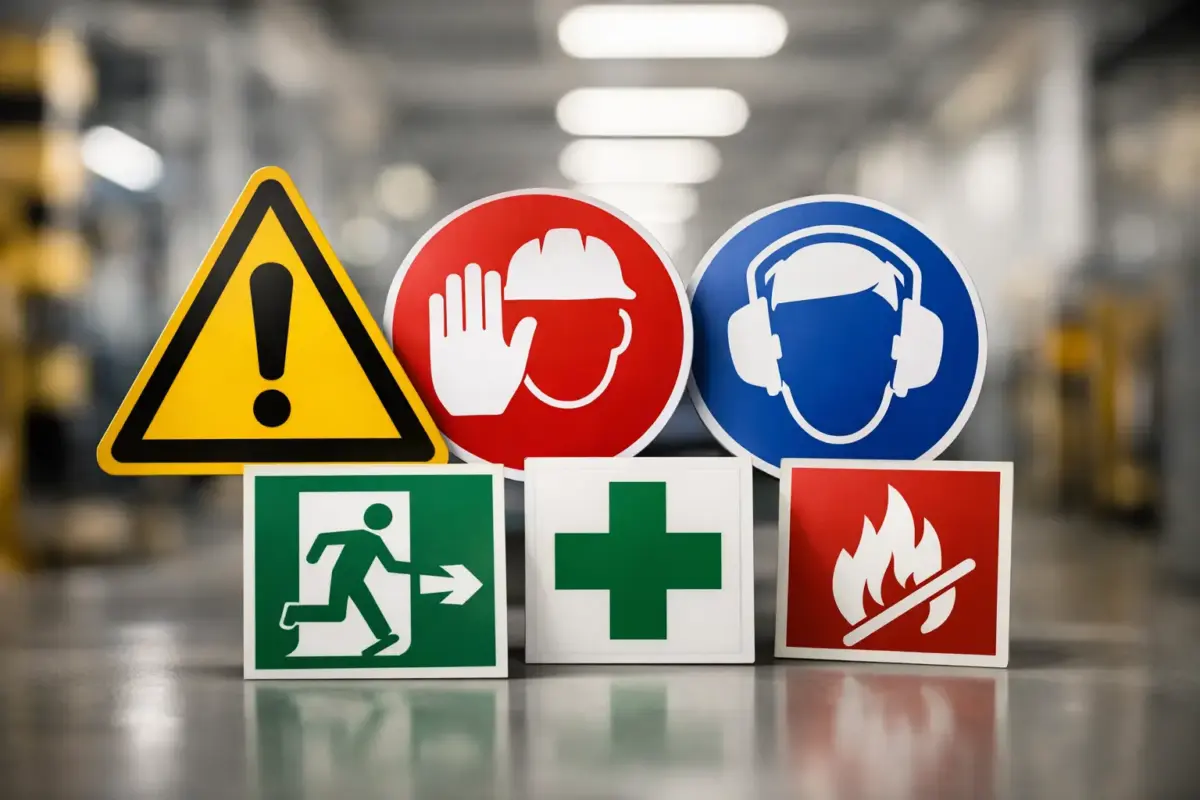
A missing warning sign is rarely noticed until someone takes the wrong route, enters a restricted area or uses equipment without understanding the risk. That is the practical importance of health and safety signs: they give people the information they need at the point they need it, helping sites run more safely and with less uncertainty.
For a workshop, building site, warehouse, shop, school, hospitality venue or shared office, clear signage supports everyday decisions. It tells staff, contractors and visitors where they can go, what protective equipment is required, which actions are prohibited and what to do if something goes wrong. Good signs are not background decoration. They are part of how a workplace communicates its rules.
Why health and safety signs matter on working sites
People do not arrive on site with the same knowledge. A long-serving employee may know that a loading bay has reversing vehicles at certain times, while a delivery driver or new contractor may not. A visible warning sign helps close that gap quickly, without relying on word of mouth or assumptions.
This matters most where hazards are immediate. Wet floors, forklifts, high-voltage equipment, moving machinery, hot surfaces, deep water and hazardous substances all require clear communication. The right sign helps make a risk visible before someone is close enough to be harmed.
Health and safety signs also support consistency. Site rules can be explained during an induction, but people forget details, visitors may not attend a full briefing and conditions can change during the day. Signs provide a permanent reminder at entrances, access points, corridors, workstations and emergency routes.
For businesses managing multiple staff, shifts or locations, standardised signs make expectations easier to maintain. A clear “Hearing Protection Must Be Worn” sign means the same thing in every production area. That reduces ambiguity and gives supervisors a straightforward way to reinforce site procedures.
Signs support risk control, but do not replace it
The importance of health and safety signs is often misunderstood as a compliance exercise: put a sign on the wall and the risk is dealt with. In reality, signage is only one part of a proper control system.
Under UK safety requirements, signs and signals should be used where a significant risk cannot be avoided or adequately controlled by other measures. If a machine guard is missing, a warning sign is not an acceptable substitute. If a floor is continually slippery because of a leak, the leak needs repairing. Signs communicate a remaining risk or an essential instruction; they do not remove the hazard itself.
That distinction is useful when choosing what to display. Start with the work activity and the risks already identified. Then consider whether a sign will give a person a clear, timely instruction that helps them act safely. In many cases, it will. In others, better segregation, equipment maintenance, training or supervision should come first.
A well-managed site uses both. Physical controls reduce exposure to danger, while clear signs tell people how to move through the area safely and what rules apply.
The four main types of safety sign
Recognisable colours, shapes and symbols allow people to understand a message quickly, including people who may not read every word. Choosing the correct category is as important as selecting a durable material or a suitable size.
Prohibition signs
These signs have a red circle with a diagonal line and tell people what they must not do. Common examples include No Smoking, No Unauthorised Access and No Mobile Phones. They are particularly useful where an unsafe action could create a fire, security or operational risk.
Mandatory signs
Mandatory signs are blue and state an action that must be taken. “Safety Helmets Must Be Worn”, “Wear Eye Protection” and “Keep Door Closed” are typical examples. Place them before a person reaches the relevant hazard, not halfway through the area where the instruction comes too late.
Warning signs
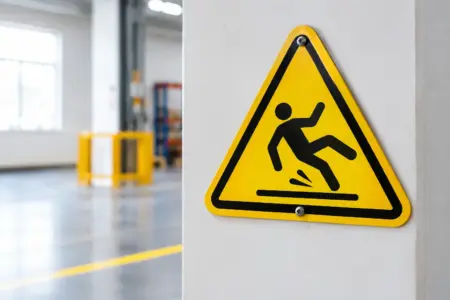
Warning signs are generally yellow with a black symbol. They highlight a hazard such as slippery surfaces, forklifts, overhead loads, corrosive materials or electricity. A warning should be specific enough to prompt care, rather than becoming a vague notice people learn to ignore.
Safe condition and fire safety signs
Green signs identify safe routes, exits, first aid points, assembly points and emergency equipment. Fire safety signs commonly use red to identify fire-fighting equipment, such as extinguishers and fire hose reels. These signs need careful positioning because they may be needed under pressure, during a power cut or by someone unfamiliar with the premises.
Placement and visibility are where signs succeed or fail
A perfectly designed sign is of little use if it is behind a parked pallet, hidden by an open door or positioned after the decision point. Site managers should walk key routes as a visitor would: from the car park to reception, through staff entrances, into work areas and towards emergency exits.
Look for the places where someone has to make a choice. This could be a gate leading to a construction area, a change from pedestrian route to vehicle route, the entrance to a plant room or the point where personal protective equipment becomes necessary. The sign should be visible before that choice is made.
Size matters too. A small notice may suit a cupboard door or individual machine, but it will not work across a busy warehouse aisle. Viewing distance, lighting, mounting height and surrounding visual clutter all affect readability. Outdoor signs need materials that can withstand rain, sunlight and everyday site wear, while temporary hazards may call for portable or freestanding signs that can be moved as work progresses.
Avoid over-signing. If every wall carries a mixture of unrelated notices, people stop looking. Use the signs needed for the risk, keep messages clear and remove temporary notices once the hazard is gone. A tidy, current sign system is more credible than a crowded wall of faded instructions.
Protecting visitors, contractors and the public
Employees may understand the working environment, but visitors and contractors cannot be expected to know its hazards. They need clear instructions from the moment they arrive.
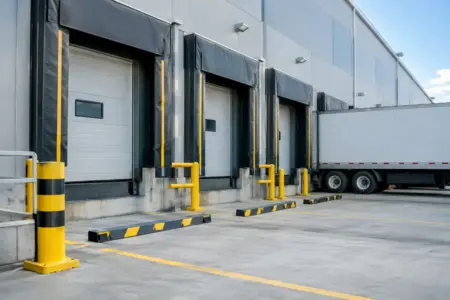
Entrance signs can direct visitors to reception, identify mandatory personal protective equipment, restrict access and explain site rules. Separate pedestrian and vehicle routes are especially valuable in yards, loading areas and premises with regular deliveries. Clear wayfinding reduces the chance of people wandering into operational areas simply because they do not know where to go.
For customer-facing premises, health and safety signage has to work without making the space feel hostile. A café may need wet floor warnings, fire exit signs and staff-only notices, while a retailer may need clear access information and temporary signs during maintenance. The aim is not to cover every surface. It is to provide the right information in a professional, easy-to-follow format.
Maintaining signs is part of the job
Safety signage should be checked as part of routine site inspections. Fading, cracked boards, peeling vinyl, outdated wording and signs obscured by stock can all weaken their purpose. A damaged sign can also suggest that other safety controls are being overlooked.
Review signs when layouts, equipment, processes or access arrangements change. A new racking system, altered fire route, additional machinery or revised visitor procedure may create a need for different signs. This is particularly relevant for growing businesses, where premises often change faster than documentation and notices are updated.
It is also worth checking that bespoke signs use plain language and familiar symbols. A sign can include a company rule, contact detail or location-specific instruction where needed, but the main safety message should remain immediate. Short wording, strong contrast and an appropriate standard symbol usually work best.
Choosing a practical signage approach
Many workplaces need a mixture of off-the-shelf and personalised safety signs. Standard notices cover common requirements quickly, while custom signs are useful for site-specific traffic routes, restricted zones, equipment instructions, reporting points and local procedures.
The right product depends on where and how it will be used. Rigid signs suit fixed walls, gates and external areas. Self-adhesive options can work well on equipment, doors and internal surfaces. Freestanding signs are useful for temporary cleaning, maintenance and event-related hazards. The key is to match the sign material, size and fixing method to the real environment rather than choosing solely on price.
The SignBuilder can help businesses bring standard safety messages and site-specific instructions into one practical order, whether the requirement is a single replacement notice or a wider set of signs for a new premises.
A clear sign will not make an unsafe process safe on its own. But when it is accurate, visible, well maintained and backed by proper controls, it can prevent a moment of confusion from becoming an incident. That is a straightforward investment in safer people, smoother operations and a site that is easier to manage.